

Create a Pre-Game That is Always the Same
- lizziedunavin
- Nov 18, 2020
- 4 min read
If you walk through a softball complex an hour before game time, you are likely to see girls jogging, stretching, warming up arms, and swinging a bat. If you walk into a gym before a basketball tournament, you are likely to see kids doing a dynamic warm up, shuffling, jogging, and shooting free throws. If you show up to a soccer game, you will likely see kids jogging, dribbling, and taking shots on the goal.
I think you get the point. Every sport has an individualized pre-game routine. These routines are highly important. One reason being injury prevention and another being an overall successful performance.
There’s a reason that in almost every sport, the first thing you see is athletes completing some sort of dynamic warm up paired with static stretching. Injury prevention is key in promoting long, healthy, journeys for athletes.
Outside of standard stretches, teams generally have a procedure they run through before each game. This is called the pre-game routine.
“Studies have shown that successful performance significantly increases when a pre-performance routine was implemented where one did not previously exist. Additionally, research has shown successful performance significantly increases when a routine is performed consistently.” (Caitlin Haworth, The importance of pre-performance routines)

All coaches, at every level, should be implementing evidenced based practices shown to increase the likelihood of a successful performance. At the end of the day, coaches want athletes to succeed. Coaches and athletes grind during practice; putting in the work to ensure they perform at the highest level possible. A pre-game routine is just one more tool to promote consistency in performance.
I currently coach softball at the high school level. However, I have coached athletes ranging from 11-18 years old. Throughout my years of coaching, I have found that pre-game routines become significantly easier to implement when athletes are old enough to take responsibility for the process. Typically, the younger the athlete, the longer it may take for athletes to be completely self-sufficient with the routine.
The example I plan to show you within this post, I typically use with my high school athletes 14-18 years old. When implementing a pre-game routine, I start by telling the athletes the reason behind keeping our warm ups the same. After giving a rationale for the routine, I tell the athletes what it will look like.
We typically have two routines, a game time routine and a practice routine. The difference being, before games we get bats and work through hitting stations after throwing. Before starting practice, we move straight into a four corners drill after throwing. Other than that, we keep the routines identical in order to practice how we will play. Our routine includes a dynamic warm up, static stretch, and throwing progression.
After telling the athletes what the routine will consist of, I model the routine step by step, having the athletes repeat. I model the routine for two or three days; this may take more or less time dependent upon the group of athletes. I tell the athletes the last day I will be modeling the routine and tell them from that day forward I will be calling on each of them to lead the pre-game routine.
The next day, I choose an athlete to run the routine while I watch. If the athlete gets stuck, I encourage them to ask a teammate what comes next, if the teammate doesn’t know, I model again. For the next five to seven days, I typically stand close to the team as they complete the routine, I ensure that each step is completed correctly and they are not missing anything. Once the team has independently completed the pre-game routine for three consecutive days, I consider it mastered and expect that the team completes it independently prior to each practice and game.
An example of this would be, practice is scheduled to start at 4:00PM. I let the girls know the expectation is that cleats are on, gloves are in their hand, and they are standing on the right field line at 4:00PM on the dot. This no longer becomes a question after the routine is mastered. If I were to show up at the field at 3:59PM, I would see girls walking to the right field line.

This routine has now instilled independence and accountability within the team. Teammates tell each other when it is time to start practice. Teammates help each other if they are missing part of the routine. The routine creates a consistent start to every practice and allows girls the time to transition their mindset from school, boys, home life, car problems, whatever may be happening in the outside world, to softball. This transition period does not require intense thought because the athletes have already mastered the routine and are able to complete it fluently.
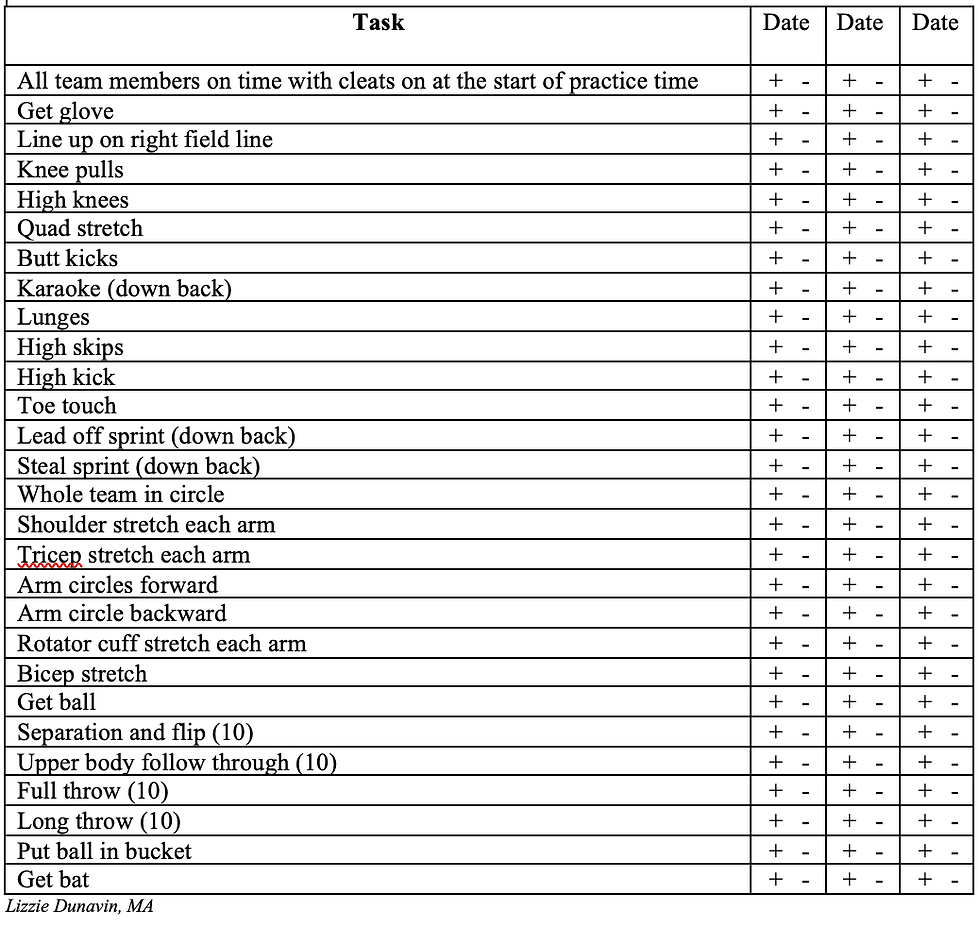
By giving our athletes time to transition with a consistent routine, we minimize the excuse of having a bad day. Thus, increasing the likelihood of a successful performance that day. One way to analyze if there is a section of the pre-game routine where athletes are struggling more than others is a task analysis. This task analysis will break down every skill you want your athletes to perform within the routine. Observe the team’s performance over a few days and it should be clear if there are skills that need to be modeled again or if there are specific athletes who are holding the team back from mastering the skill. By showing the team as a whole their score each practice, you may see athletes starting to hold each other accountable.
Provide reinforcement for the athletes once they have mastered the routine. This could look like once the team gets 100% on the task analysis three days in a row, they will get out of practice 15 minutes early. Working toward a common goal should build team morale and responsibility.
Below is an example of my task analysis I currently use when teaching my pre-game routine.
Reference:


Comments